A straight-talking guide from Focus Media Outdoor — over 20 years in the industry
It’s a question we get asked a lot — should I be spending my budget on outdoor advertising or digital advertising? And the honest answer is that the question isn’t really either/or. OOH advertising and digital advertising do different jobs, reach people in different ways and work best when they’re used together. But if you’re trying to decide where to put your budget, it helps to understand what each one is good at — and where each one falls short. In this guide we give you a straight-talking, no-nonsense comparison. We’re an outdoor advertising agency, so we obviously believe in the power of OOH — but we’ll give you the full picture, not just our side of the story. If you’d like to talk through what the right mix looks like for your business, our campaign planning team are happy to help.
What Is OOH Advertising?
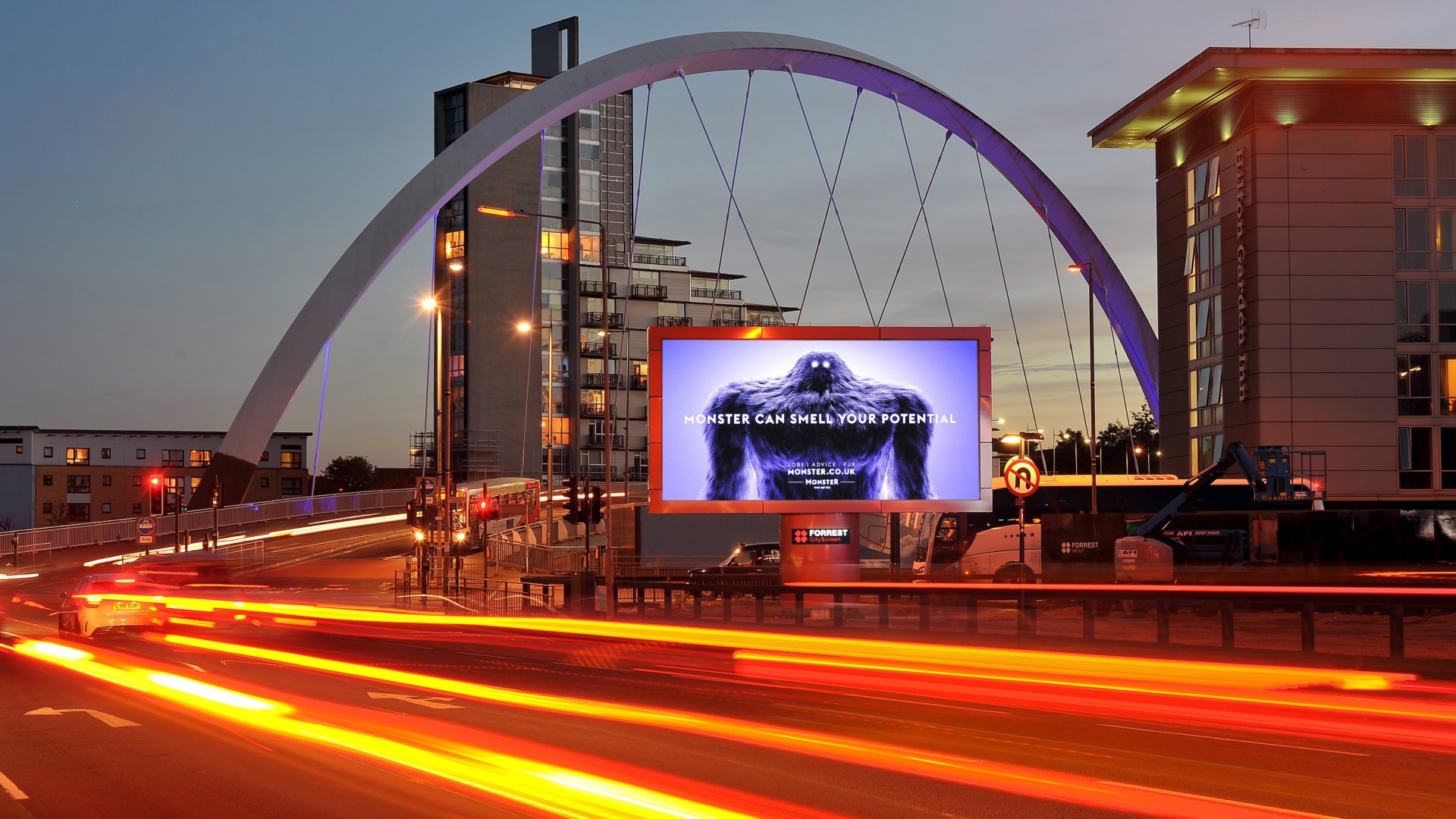
OOH stands for Out of Home advertising — it’s the umbrella term for any advertising that reaches people while they’re outside their home. Billboards, bus stop adverts, bus sides, train station posters, shopping centre screens, airport advertising — all of this falls under the OOH banner. It’s one of the oldest forms of advertising in existence and, despite the rise of digital, it’s as relevant and effective as ever.
The defining characteristic of OOH advertising is that it’s physical, it’s public and nobody can switch it off, skip it or block it. For a full overview of the different formats available, take a look at our guide to how to plan an outdoor advertising campaign.
What Is Digital Advertising?
Digital advertising covers any paid advertising that appears online — Google search ads, social media ads (Facebook, Instagram, LinkedIn, TikTok), display ads on websites, YouTube pre-rolls, programmatic advertising and more. It’s data-driven, highly targeted and measurable in real time. You can set a budget, define your audience and track exactly how many people clicked, converted or took an action as a result of seeing your ad.
The rise of digital advertising over the last 20 years has been extraordinary — and for good reason. The targeting capabilities and measurability are genuinely impressive. But it’s not without its drawbacks, which we’ll come to.
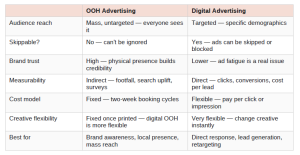
OOH vs Digital — A Side by Side Comparison
Where OOH Advertising Wins
It Can’t Be Ignored
This is the single biggest advantage of OOH advertising over digital — you simply cannot skip it, block it or scroll past it. Ad blockers, skip buttons and banner blindness have made digital advertising increasingly difficult to get in front of people. A billboard on a busy road, a bus stop advert on the high street or a bus side travelling through a town centre is unavoidable. People see it whether they want to or not.
It Builds Trust and Credibility
There’s a reason that established, trusted brands consistently use outdoor advertising — it carries weight. Seeing a brand on a billboard or a bus stop gives it a physical presence in the real world that digital advertising simply can’t replicate. For smaller or newer businesses in particular, OOH advertising is one of the fastest ways to build local credibility and brand recognition.
Businesses that advertise on billboards and bus stops are perceived as more established and trustworthy by consumers. Physical advertising in the real world carries a credibility that digital ads struggle to match.
Mass Reach at Scale
A well-chosen billboard or bus advertising campaign can reach tens of thousands of people every day — people of all ages, demographics and income levels. Digital advertising can target specific demographics precisely, but OOH reaches everyone in a geographic area, including people who don’t use social media, use ad blockers or simply aren’t online at the moment they’re in your target area.
No Algorithm Changes or Platform Risk
Digital advertisers live at the mercy of platform algorithms and policy changes. A Facebook algorithm update, a Google policy change or an iOS privacy update can wipe out a digital campaign’s performance overnight. OOH advertising has none of these risks — your billboard goes up and stays up for the duration of your booking, completely immune to whatever is happening in the digital landscape.
Works Around the Clock
An illuminated billboard or backlit bus stop advert works 24 hours a day, seven days a week, for the full duration of your campaign. There’s no daily budget cap, no ad fatigue and no auction to win. It’s just there, working for your business day and night.

Where Digital Advertising Wins
Precise Targeting
Digital advertising’s ability to target specific audiences is genuinely impressive. You can target by age, location, interests, income, job title, search intent, past website behaviour and much more. For campaigns that need to reach a very specific type of person rather than a broad geographic audience, digital targeting is hard to beat.
Real-Time Measurability
With digital advertising, you know exactly what you’re getting — clicks, impressions, cost per lead, conversion rate, return on ad spend. The data is instant, granular and actionable. If a campaign isn’t working, you can change it immediately. This level of measurability is something OOH advertising can’t match directly, though there are ways to measure OOH effectiveness — take a look at our guide to measuring OOH ROI for more on this. Take a look at our guide to how to measure ROI from OOH advertising for practical techniques.
Flexibility and Speed
Digital campaigns can be set up, changed and turned off almost instantly. If you need to react quickly to a market opportunity, promote a flash sale or test different messages, digital advertising gives you that flexibility. OOH advertising requires more lead time — artwork needs to be produced, sites need to be booked and posters need to be printed and posted.
Lower Entry Cost
You can start a digital advertising campaign with a very small budget — in theory, a few pounds a day on Google or Facebook. OOH advertising has a higher minimum entry cost, though formats like bus stop advertising and bus rears are far more affordable than many people expect. For very small budgets, digital may be the more practical starting point.
The Real Answer — Use Both Together
Here’s the thing — the most effective marketing campaigns don’t choose between OOH and digital. They use both, with each format doing what it does best.
OOH advertising builds awareness. It puts your brand in front of a mass audience repeatedly, building familiarity and trust over time. Digital advertising then converts that awareness into action — when someone who’s already seen your billboard searches for your product online, your Google ad is there to capture them. The two work together in a way that neither can achieve alone.
Research consistently shows that OOH advertising significantly increases the effectiveness of digital campaigns running alongside it. People who see an OOH advert are more likely to search for the brand, more likely to engage with digital ads and more likely to convert. Outdoor advertising primes the audience — digital closes the sale.
OOH and digital advertising are not competitors — they’re partners. One builds awareness and drives search, while the other captures that demand and converts it. Together, they’re significantly more effective than either format on its own.
Which Should You Choose for Your Business?
Here’s a simple guide based on your objective:
Choose OOH advertising if:
• You want to build brand awareness in a specific local area
• Launching a new business, product or service means you need to get noticed quickly
• Your audience is broad, rather than highly specific
• Around-the-clock visibility matters more than constant campaign management
• Building credibility and a physical presence in your community is important
• The campaign is time-sensitive, such as an event, opening or deadline
Choose digital advertising if:
• You need to target a very specific demographic or interest group
• A smaller budget means you need maximum flexibility
• Immediate, detailed performance data is important to your campaign
• The goal is direct response, such as clicks, enquiries or conversions
• Your message needs to be changed quickly and regularly
Choose both if:
• You want the strongest overall results — this is almost always the right answer
• Building a long-term brand matters, but you still need short-term enquiries or sales
• Your budget allows you to invest in both awareness and response at the same time
Not sure where to start? Our campaign planning team can help you work out the right mix for your business and your budget — completely free of charge.
What Does OOH Advertising Cost Compared to Digital?
Cost comparisons between OOH and digital are tricky because they’re measured differently. Digital is typically measured by cost per click or cost per thousand impressions (CPM). OOH is measured by the cost of the site for a fixed period. What we can say is that OOH advertising is far more affordable than most people expect — a bus stop advert starts at around £275 for two weeks all in, and a billboard from around £400. For the number of people those formats reach, the cost per thousand is extremely competitive with digital — and without the ad fatigue, blocking or algorithm risk.
Ready to Add OOH to Your Marketing Mix?
Get in touch with the team at Focus Media Outdoor. We’ll help you understand what OOH advertising can do for your business, find the right formats and locations for your budget and make sure your campaign works alongside whatever else you’re doing. Contact us today for a free no-obligation conversation.